
Building Automation + Performance
LED saves energy. Controls save the rest.
Even after an LED retrofit, fixtures still run at full power when nobody is there. Automation fixes that — wireless sensors, dimming, scheduling, occupancy sensing, and BAS integration that cut energy another 30-40% and can nearly double fixture life. Installed, commissioned, and verified by one accountable contractor.
The Problem
Your LED fixtures are still running when they do not need to be.
A parking lot with 200 LED fixtures running at full output from dusk to dawn is wasting energy every hour the lot is empty. Interior fixtures in stairwells, storage rooms, and common areas burn all day whether anyone is in them or not.
Controls solve the problem LED alone cannot: they match light output to actual demand. The result is 30-40% additional energy savings on top of your LED retrofit, plus reduced thermal stress that can nearly double fixture life — eliminating an entire replacement cycle.
A third value layer that most properties overlook: utility demand response. Many utilities run commercial programs that pay participating buildings to automatically shed electrical load during peak grid events — typically a handful of times per year during extreme heat or high-demand periods. Networked per-fixture controls qualify because lighting is a large, individually addressable load that can be safely dimmed during a curtailment event without disrupting tenants or operations. FERC Order 745 established that demand response resources should be compensated comparably to power generation; retail utility programs have followed. Where your utility runs an active program, your controls system can earn bill credits or capacity payments on events that would otherwise pass unnoticed. (Source: FERC Order 745; specific program terms vary by utility and ISO territory — we identify active programs for your market.)
The market has moved this direction decisively. The smart-connected commercial lighting segment is growing at roughly a 19% CAGR (Mordor Intelligence, 2026), with the lighting-controls sub-market growing at ~14% on its own. Utilities are following: per-product rebate averages rose about 17% entering 2026 (BriteSwitch, 2026), and code and rebate programs are converging — California’s Title 24 energy code and Mass Save’s large-C&I incentives already require controls on qualifying LED work, and other utility programs are trending the same direction. If you are not specifying controls on your next retrofit, you may be leaving both energy savings and rebate money on the table.
What controls actually do
Four everyday scenarios. Same building — cheaper to run.
Controls are simple in principle: match light output to what the building actually needs, moment by moment. Here’s what that looks like in practice.
The parking lot dims after hours
At 11 PM the lot drops to 30% output. A car pulls in and the fixtures around it snap back to full for 5 minutes, then fade down.
Empty rooms turn themselves off
Stairwells, storage rooms, back-of-house, and after-hours offices hold at low or off until someone walks in.
Schedules track the sun
Exterior fixtures fire on the astronomical clock, not a drifting photocell. Interior schedules follow business hours automatically.
One dashboard, whole portfolio
Failures show up before a tenant calls. Schedule changes push to every property at once. Nothing lives on a whiteboard.
Four methods
Four ways controls stop paying to light an empty space.
Dimming
Reduce output when full light is not needed. Parking lots dim to 30% after hours and restore to 100% on motion detection. Interior spaces dim based on available daylight.
Scheduling
Automated on/off tied to time of day, season, and astronomical clock. No more relying on photocells that drift or manual switches that get left on.
Occupancy Sensing
Motion and presence detection at the fixture level. Lights respond to actual use — stairwells, storage areas, parking decks, and after-hours spaces dim or shut off when empty.
BAS Integration
Connect lighting to your building automation system — and, where your utility offers demand response programs, position your controls to participate in curtailment events that pay you for automated load shedding. One dashboard for lighting, HVAC, and electrical monitoring. Centralized scheduling across your entire portfolio.
The hardware
One sensor per fixture. No gateway. No subscription.
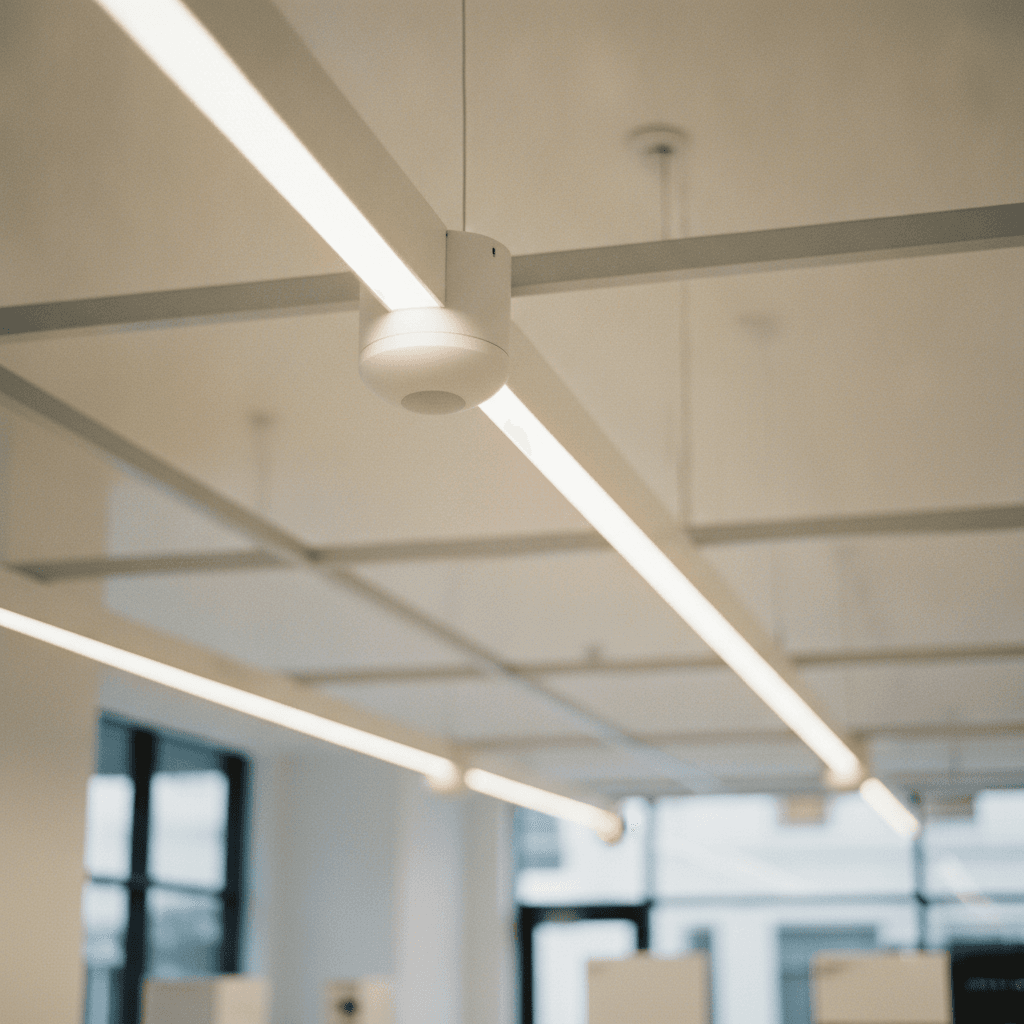
Every LED fixture on a controls project gets a small wireless sensor mounted at the head of the pole or on the housing. It sees motion in its zone, listens to the schedule, dims and brightens on command, and reports its status back.
A standalone wireless platform doesn’t need a gateway, a hub, or a monthly cloud subscription to work. The sensor is the intelligence. That’s why we default to it on most commercial exterior projects.
- Per-fixture control — no zone-wide averaging
- DLC-qualified for utility rebate programs
- Manufacturer warranty on every sensor
- Runs on the fixture’s own power — no separate wiring
Platforms we install
Matched to what your building actually needs.
We are not locked to one manufacturer. We spec the right controls platform based on your building type, fixture count, budget, and whether you need standalone sensors or networked management.
Standalone wireless sensors
The industry benchmark for commercial exterior wireless controls. One wireless sensor per fixture — no gateway, no subscription, no IT involvement. Per-fixture 0-10V dimming responds to each individual motion event, so a single car in a 500-space lot lights only the fixtures it needs. DLC-qualified for utility rebate programs. Where most of our exterior projects start.
Networked mesh controls
Mesh network for indoor and outdoor on one system. DLC NLC5.0 qualified. Centralized scheduling and monitoring across large portfolios — single dashboard for multiple buildings and sites.
BAS Integration
Connect controls to your existing building automation system. One interface for lighting, HVAC, and electrical monitoring. Works with BACnet, Modbus, and DALI protocols. Standard choice for properties with active BAS infrastructure.
The numbers
Energy is only half the value.
Based on measured results from our own installs.
Controls value is not just energy. Reduced thermal stress can nearly double fixture life, eliminating a full replacement cycle over the life of the system. That deferred cost is real money — and most property managers do not account for it when evaluating controls.
30-40%
Additional energy savings
Dimming, scheduling, and occupancy sensing on top of your LED retrofit
~2x
Fixture life extension
Reduced thermal stress defers an entire replacement cycle
Lower
Maintenance costs
Fewer failures from lower thermal stress means fewer service calls
LED + Controls Combined
Adding controls during the LED retrofit extends your payback only marginally — while nearly doubling fixture lifespan.
<3 yr
Typical combined payback
~2x
Fixture life
What you get
Installed, commissioned, and verified.
Controls are only as good as their configuration. We install the hardware, commission every sensor, tune the schedules, and verify the savings with real energy data.
- Controls strategy matched to building type and use
- Sensor and controller hardware installation
- Scheduling, dimming, and occupancy programming
- BAS integration and protocol bridging where applicable
- Post-install energy verification with before/after data
- Demand response pre-qualification and utility program documentation
- Ongoing support, seasonal adjustments, and firmware updates
Automation + maintenance go together
Controls without maintenance drift out of spec fast.
Every commissioned controls project degrades. Schedules drift as seasons change. Sensors get bumped out of alignment. Firmware needs updating. Occupancy patterns shift as tenants turn over. Two years after commissioning, a system that nobody maintains is usually delivering half the savings it did on day one.
Preventive maintenance is the answer. Monthly inspections catch sensor drift. Scheduled tuning restores seasonal setpoints. Firmware and platform updates happen on our schedule, not yours. And when a fixture fails, the covered repair is already covered by the monthly plan — no surprise invoices, no delayed responses.
Controls in action
Running today at Adidas, America’s Thrift Stores and Great Southern Wood.
One networked controls platform runs a distribution center, a retail chain and a manufacturer. We install it, commission it and support it after handoff.
Distribution
Adidas
Spartanburg, SC distribution center
Networked wireless sensors and area controllers at the Spartanburg distribution center. When the operation needs more coverage, we add sensors to the same system.
- Wireless sensors and area controllers
- Sensors added as the operation grows
- Platform support renewed annually
Retail
America’s Thrift Stores
Stores and donation centers across the Southeast
Lighting and HVAC thermostats run on the same networked platform. When settings need to change, we change them for every store at once instead of driving to each one.
- Lighting and HVAC on one system
- HVAC settings changed chain-wide
- A client since 2019
Manufacturing
Great Southern Wood
Plant and yard lighting
Networked controls across their plant and yard lighting, with our controls team watching it remotely.
- Plant high bays with sensors
- Yard lighting we installed
- Monitored remotely by our controls team
More controls case studies
Questions we hear on controls and automation.
What is the difference between LED alone and LED with controls?
LED saves energy by being more efficient than the fixture it replaces. Controls save energy by matching output to actual demand — turning fixtures off or dimming them when spaces are empty or do not need full output. In commercial exterior applications, controls add 30-40% additional savings on top of the LED upgrade.
Which controls platform do you recommend?
For commercial exterior lighting, standalone wireless sensors are the benchmark — no gateway, no subscription, and each sensor is independently addressable so a single event lights only what it needs to. The sensors we install are DLC-listed and accepted by virtually every utility rebate program. For networked indoor/outdoor applications or multi-site portfolios requiring centralized dashboard access, we install networked mesh controls instead. We spec based on the building type and rebate program requirements — not brand loyalty.
Can I add controls to existing LED fixtures?
Yes, if the fixtures are dimmable — most modern LEDs are. We install external or integrated controls on existing fixtures without replacing them. This is common for properties that did LED retrofits 3-5 years ago and want to add controls now.
How much do controls cost on top of LED?
Controls add a defined per-fixture cost — hardware plus installation labor — that is typically recouped within the same payback window as the LED itself. Because controls add 30-40% additional energy savings and nearly double fixture life, they extend payback only marginally while materially improving lifetime ROI. We price the controls layer separately in every proposal, sized to your fixture count and rebate territory, so you can evaluate it on its own merits.
Do controls require a subscription?
Not for standalone wireless sensors. Networked systems typically have annual cloud subscriptions for remote monitoring and programming. We will tell you upfront whether your use case justifies the subscription cost.
Will occupancy sensors cycle lights on and off in front of tenants?
No. Properly commissioned sensors use time delays — typically 5-15 minutes of no motion before dimming — and gradual dimming rather than hard off. In retail applications, we tune sensors so customers never notice the change. Only the utility bill does.
How do controls affect rebate capture?
Significantly — and the trend is accelerating. Per-product rebate averages rose about 17% entering 2026 (BriteSwitch, 2026), and most utility programs now incentivize LED and controls as a combined measure. California's Title 24 energy code and Mass Save's large-C&I incentives already require controls on qualifying LED work, and other utility programs are moving the same direction. The sensors we install are DLC-listed to satisfy these program requirements. Adding controls materially increases rebate capture on most projects. We handle all program paperwork and documentation.
Can my building earn utility payments through demand response?
Many utilities offer commercial demand response programs that compensate participating buildings for automatically reducing electrical load during peak grid events — typically a handful of times per year during extreme weather or high-demand periods. Networked per-fixture controls qualify because lighting is a large, individually addressable load that can be safely dimmed during curtailment without disrupting operations or tenants. FERC Order 745 established that demand response resources should be compensated at rates comparable to power generation, and retail utility programs have followed that framework. Whether a program is active in your market depends on your utility and ISO territory — programs vary considerably. We help qualifying properties identify active programs and document the controls configuration required to enroll. This is a value layer that stacks on top of energy savings and rebates, not a replacement for them.